The Greek World by Powell Anton
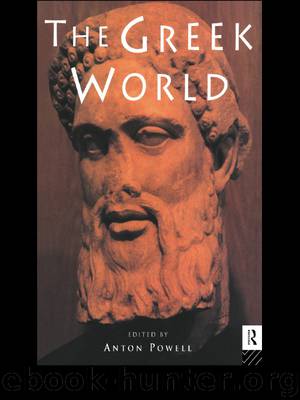
Author:Powell, Anton.
Language: eng
Format: epub
Tags: ebook
Publisher: Taylor & Francis Ltd
Published: 2011-10-31T16:00:00+00:00
NOTES
* The first version of this chapter was delivered at a conference on Herodotus’ Book II held at Johns Hopkins University, Baltimore, in 1991. Subsequent versions were read to the Classics Society of Saint David’s College, Lampeter, later in that year, and to the Friends of the Petrie Museum, University College London, in 1992. I benefited greatly from the discussions generated on all these occasions.
1 To my knowledge there has never been a detailed and systematic discussion of this topic, though observations abound in many works on details. C.Sourdille covers the sites in his La durée et l’étendue du voyage d’Hérodote en Egypte, Paris, 1910, but his account is long outdated and, in any case, always lacked an adequate purchase on Egyptological data. Several writers have discussed Herodotus’ accounts of individual monuments, e.g. O.K. Armayor, Herodotus’ Autopsy of the Fayoum: Lake Moeris and the Labyrinth of Egypt, Amsterdam, 1985.
2 Sources for Egypt have been much discussed of late: see Alan B.Lloyd, Herodotus Book II. Introduction, Leiden, 1975, pp. 77ff.; id., ‘Herodotus’ account of Pharaonic history’, Historia 37 (1988), pp. 22ff.; id., ‘Herodotus on Egyptians and Libyans’, in O.Reverdin and B.Grange (eds), Hérodote et les peuples non grecs (Entretiens sur l’antiquité classique 35), Vandoeuvres-Genève, 1990, pp. 223ff.: cf. id., ‘Herodotus on Cambyses. Some thoughts on recent work’, in A.Kuhrt and H.Sancisi-Weerdenburg (eds), Achaemenid History. III. Method and Theory (Proceedings of the London 1985 Achaemenid History Workshop), Leiden, 1988, pp. 57ff. Less sanguine views of his veracity in such matters will be found in D.Fehling, Die Quellenangaben bei Herodot, Berlin and New York, 1971, tr. J.G.Howie, Herodotus and his ‘Sources’. Citation, Invention and Narrative Art (ARCA 21), Leeds, 1989, and Armayor, ‘Did Herodotus ever go to Egypt?’ JARCE 15 (1980), pp. 59ff.; id., ‘Sesostris and Herodotus’ autopsy of Thrace, Colchis, inland Asia Minor, and the Levant’, HSPh 84 (1980), pp. 51ff.; id., Lake Moeris, op. cit.
3 For a detailed analysis of all these passages see Lloyd, Herodotus Book II. Commentary 99–182, Leiden, 1988, nn. ad loc.
4 For details on building methods see Lloyd, Commentary 99–182, nn. on chs 124–5. Discussions of the topic which appeared after the completion of that book—and of unequal value—are: M.Isler, ‘Concerning the concave faces on the Great Pyramid’, JARCE 20 (1983), pp. 27ff.; M.Lehner, ‘Some observations on the layout of the Khufu and Khafre pyramids’, JARCE 20 (1983), pp. 7ff.; I.Hafemann, ‘Zum Problem der staatlichen Arbeitspflicht im alten Ägypten. I: Die Königlichen Dekrete des Alten Reiches’, Altorientalische Forschungen 12 (1985), pp. 3ff.; id., ‘Zum Problem der staatlichen Arbeitspflicht im alten Ägypten. II: Auswertung der Expeditionsinschriften des Mittleren Reiches’, ibid., pp. 179ff.; Isler, ‘On pyramid building’, JARCE 22 (1985), pp. 129ff.; Lehner, ‘The Development of the Giza necropolis: the Khufu project’, MDAIK 41 (1985), pp. 109ff.; id., ‘A contextual approach to the Giza pyramids’, Archiv für Orientforschung 32 (1985), pp. 136ff.; id., ‘The Giza plateau mapping project: season 1984–1985’, Newsletter ARCE 131 (1985), pp. 23ff.; J.Dorner, ‘Form und Ausmasse der Knickpyramide. Neue Beobachtungen und Messungen’, MDAIK 42 (1986), pp.
Download
This site does not store any files on its server. We only index and link to content provided by other sites. Please contact the content providers to delete copyright contents if any and email us, we'll remove relevant links or contents immediately.
| Africa | Americas |
| Arctic & Antarctica | Asia |
| Australia & Oceania | Europe |
| Middle East | Russia |
| United States | World |
| Ancient Civilizations | Military |
| Historical Study & Educational Resources |
The Daily Stoic by Holiday Ryan & Hanselman Stephen(3330)
The Fate of Rome: Climate, Disease, and the End of an Empire (The Princeton History of the Ancient World) by Kyle Harper(3071)
People of the Earth: An Introduction to World Prehistory by Dr. Brian Fagan & Nadia Durrani(2743)
Ancient Worlds by Michael Scott(2694)
Babylon's Ark by Lawrence Anthony(2688)
The Daily Stoic by Ryan Holiday & Stephen Hanselman(2589)
Foreign Devils on the Silk Road: The Search for the Lost Treasures of Central Asia by Peter Hopkirk(2474)
India's Ancient Past by R.S. Sharma(2464)
MOSES THE EGYPTIAN by Jan Assmann(2426)
The Complete Dead Sea Scrolls in English (7th Edition) (Penguin Classics) by Geza Vermes(2297)
The Earth Chronicles Handbook by Zecharia Sitchin(2239)
Lost Technologies of Ancient Egypt by Christopher Dunn(2232)
24 Hours in Ancient Rome by Philip Matyszak(2094)
Alexander the Great by Philip Freeman(2069)
Aztec by Gary Jennings(2036)
The Nine Waves of Creation by Carl Johan Calleman(1927)
Curse Tablets and Binding Spells from the Ancient World by Gager John G.;(1870)
Before Atlantis by Frank Joseph(1861)
Earthmare: The Lost Book of Wars by Cergat(1832)
